JA-155J
Universal transmitter
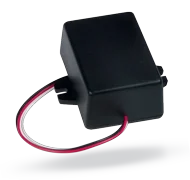
A transmitter for installation in a vehicle that converts the supply voltage applied to it into a radio command to the JABLOTRON system. From the car, you can open the garage door or a parking barrier and also transfer an alarm from the car alarm to the home system. It is installed by a trained technician with a valid JABLOTRON certificate.
Compatibility
JA-100K, JA-101K, JA-106K, JA-103K, JA-107K, JA-108K
Check compatibilityKey specifications
- Voltage supply
- 12 V to 24 V DC
- Current consumption in standby mode
- 5 mA
- Current consumption during transmission
- 24 mA
- Maximum radiofrequency output (ERP)
- 1 mW
- Communication band
- 868.1 MHz, JABLOTRON protocol
- Communication range
- approx. 300 m (open area)
- Configurable input reactions
- 1 or 2 pulses of voltage supply
Basic description
The vehicle transmitter comes in two versions, which differ in what can be done with the activation wires. With the JA-155J, you choose the reaction of each of the three activations in F-Link, so one transmitter can set the system, switch a PG output and trigger a hold-up alarm. With the JA-185J, the commands are determined by the wiring: the red wire sends SET, the white UNSET and both together the Panic signal. The deciding factor is therefore whether the commands should be configurable or fixed.
- The transmitter has nothing to press. It sends an activation the moment positive voltage reaches its wire, so any circuit in the vehicle that can switch voltage becomes a control.
- It is powered directly from the vehicle's on-board power system and does not need a permanent power supply, because it sends the signal at the moment the power is connected.
- You choose the reaction of each of the three activations in F-Link, so one transmitter can handle setting, control of an appliance via a PG output and a hold-up alarm all at once.
- One transmitter can be enrolled to any number of JABLOTRON systems and to AC-16x series multifunction relays; for enrolment to a relay, the Continuous transmission for Copy PG function must be enabled.
Why choose this product
How an activation is generated
An activation is triggered by positive supply voltage applied to one of the activation wires. The black wire is ground, the red and white wires are for activation, and voltage can be applied to them by any circuit in the vehicle that can be switched. The signal is only sent at the moment the power is connected, so for a further activation the power must first be disconnected and reconnected. The two activation wires work independently: if one is permanently live, the other remains functional.
- Activation A is sent by positive voltage on the red wire, activation B on the white wire and activation A+B by voltage on both at the same time; the choice of reactions differs for each of them
- As standard, the transmitter sends the signal as soon as power is first applied; a jumper inside can switch it to react only to a second application, which must follow within 2 s
- It transfers an alarm from the car alarm to the home system: both the red and the white wire are connected to the alarm output of the car alarm, which switches positive voltage during an alarm, and the Panic or Report reaction is assigned to the activation in F-Link
What the system must provide
The transmitter is a peripheral of the JABLOTRON security system: it is enrolled in a similar way to a keyfob, except that instead of operating a keyfob, the activation wires are connected to the power supply. It can also be enrolled by entering the serial number in F-Link.
- The control unit must have a JA-11xR radio module
- The transmitter occupies one position in the system
- The communication range is up to 300 m in direct line of sight
Where it belongs in the vehicle
The transmitter belongs inside the vehicle, typically in the dashboard. It is fixed to a plastic part with screws or by gluing and should not be mounted on metal surfaces, because metal shields the signal and shortens the range. The lead wires also serve as an antenna, so their length must be taken into account when choosing the location.
- Powered from the 12 to 24 V DC on-board power system with a tolerance of ± 30 %; nominal current draw 5 mA and maximum 24 mA
- The operating temperature range of −40 to +85 °C covers the vehicle environment, but the storage range is only −10 to +40 °C
- Complies with UNECE Regulation No. 10 on electromagnetic compatibility in vehicles
Frequently asked questions
By voltage, not by hand. In the vehicle, the activation wire is connected to a circuit that can already be switched, so you send the command with a normal control of the vehicle, or with a switch that is added. What happens in the system as a result is assigned to each activation separately in F-Link.
Yes. The alarm output of the car alarm is connected to the activation wires, and the transmitter transfers the alarm from the vehicle to the same system that guards the house.
Technical specifications
- Voltage supply
- 12 V to 24 V DC
- Current consumption in standby mode
- 5 mA
- Current consumption during transmission
- 24 mA
- Maximum radiofrequency output (ERP)
- 1 mW
- Communication band
- 868.1 MHz, JABLOTRON protocol
- Communication range
- approx. 300 m (open area)
- Configurable input reactions
- 1 or 2 pulses of voltage supply
- Operational temperature range
- -40 °C to +85 °C
- Storage temperature range
- -10 °C to +40 °C
- Dimensions, weight
- 84 x 53 x 25 mm, 120 g
- IP coverage
- IP41
- In compliance with
- ETSI EN 300 220-1,-2, EN 50130-4 ed.2+A1, EN 55032, EN 62368-1, EN 50581, EHK10
- Can be operated according to
- ERC REC 70-03
Warning
- No functions are set at the factory, so until you assign reactions to the activations in F-Link, the transmitter does not control anything. The lead wires serve as an antenna: shortening them below 30 cm or mounting on metal reduces the range. Do not use the Copy PG function where the input may remain permanently switched on while the vehicle is out of range of the control unit, for example when connected to the full-beam headlights; the control unit then stops responding to the transmitter, and it must be enrolled again. In addition, the alarm output of the car alarm must not confirm operation of the car alarm, otherwise an alarm would also be sent during normal operation of the car alarm.
Installation example
Choose a place inside the vehicle, for example in the dashboard, away from metal surfaces.
Fix the transmitter to a plastic part of the vehicle with screws or by gluing.
Do not shorten the lead wires below 30 cm; they also serve as an antenna.
Connect the black wire to ground and the red and white wires to positive voltage sources according to the required activations. An existing element of the vehicle, for example the headlight flasher, can be used for control from the vehicle; in that case, enable the reaction to two pulses.
To transfer an alarm from the car alarm, connect both the red and the white wire to its alarm output, which switches positive voltage during an alarm.
Switch the control unit to service mode.
In F-Link, select a position on the Devices tab and switch on enrolment mode with the Enrol option.
Check that the jumper inside the module is closed.
Connect the black wire to GND and both activation wires to the power supply for 4 seconds. The transmitter sends the enrolment signal. It can also be enrolled by entering the serial number from the bar code label on the back.
In the Internal settings on the Devices tab, assign reactions to activations A, B and A+B.
Help us improve the catalog
Missing something, or found a mistake? Let us know.