JA-151ST
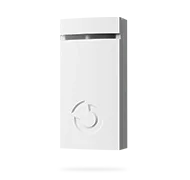
Wireless combined smoke and heat detector with built-in siren
On detecting smoke or a sharp rise in temperature it starts to sound and at the same time transmits an alarm to the system.
Product line
- JABLOTRON 100+
- JABLOTRON Mercury
Compatibility
JA-100K, JA-101K, JA-106K, JA-103K, JA-107K, JA-108K, JA-102K, JA-152KRY
Check compatibilityKey specifications
- Power
- 3 x Alkaline battery type LR6 (AA) 1.5 V/2.4 Ah Please note: Batteries are not included
- Typical lifetime
- approx. 3 years
- Smoke detection
- optical light scattering
- Smoke detector sensitivity
- m = 0.11 ÷ 0.13 dB/m pursuant to EN 14604:2005, EN 54-7
- Heat detection
- class A1 according to EN 54-5
- Alarm temperature
- +60 °C to +65 °C
- Communication band
- 868.1 MHz, Jablotron protocol
Basic description
The detector detects a fire as it starts and makes an immediate response or timely evacuation possible. Besides transmitting an alarm to the system, it also works completely on its own and so meets the requirements for a stand-alone fire detector, which is essential in residential construction.
- Fire signalled locally by the detector itself and also by the system keypads and sirens
- Immediate remote warning in MyJABLOTRON and to the Alarm Receiving Centre
- Stand-alone operation even if the system is unavailable
- Thanks to the temperature sensor it also responds to a fire without smoke (flammable liquids and similar)
Why choose this product
Where the detector can be used
Smoke detection is intended for households or office spaces without increased dust levels, which may cause false alarms or shorten the life of the optical chamber. For use in a more demanding environment, the reaction to smoke can be disabled.
- In households or offices, rapid detection of smoke as well as of a rise in temperature
- In warehouses or workshops, a slower reaction to temperature only, or a mandatory match of both conditions
- During dusty work indoors, cover the detector or remove it
Placement
The more detectors, the sooner a fire is caught. The minimum is 1 detector in the connecting hallway, which smoke from the adjoining rooms can reach. In a multi-storey house, also the space above the staircase, where smoke naturally rises. Ideally, cover all the rooms at risk.
- The kitchen, where fires caused by cooking start most often
- The living room, where the risk comes not only from a fireplace but also from candles or a Christmas tree
- Utility rooms or a garage with equipment at risk, such as battery storage or chargers
Where not to put the detector
Do not position detectors in places where air flow or obstacles on the ceiling could prevent smoke from reaching them. At the same time, avoid places directly above a source of steam or hot air, where spurious alarms are a risk.
- Directly above an oven, hob or fireplace, in bathrooms and saunas
- Close to air conditioning outlets from which fresh air flows
- In corners, at the apex of a sloping ceiling or in the space between beams, where air flow is restricted
Frequently asked questions
JA-151ST has a built-in siren, so it warns the people present immediately. The smoke detection is identical in both.
The optical smoke sensor is sensitive, and cigarette smoke in larger quantities can activate it. Do not install it in smoking rooms or in kitchens directly above the cooker.
At least once a month, by pressing the detector body against the base; the smoke part with a test spray and the heat part with a stream of hot air. Never test the detector with a naked flame.
Technical specifications
- Power
- 3 x Alkaline battery type LR6 (AA) 1.5 V/2.4 Ah Please note: Batteries are not included
- Typical lifetime
- approx. 3 years
- Smoke detection
- optical light scattering
- Smoke detector sensitivity
- m = 0.11 ÷ 0.13 dB/m pursuant to EN 14604:2005, EN 54-7
- Heat detection
- class A1 according to EN 54-5
- Alarm temperature
- +60 °C to +65 °C
- Communication band
- 868.1 MHz, Jablotron protocol
- Effective Radiated Power (ERP)
- 10 mW
- Communication range
- approx. 300 m (unrestricted area)
- Dimensions
- diameter 126 mm, height 50 mm
- Weight
- 150 g
- Operating temperature range
- -10 °C to +65 °C
- Also complies with
- EN 54-25, ETSI EN 300 220, EN 60950-1, EN 50130-4 and EN 55022.
- Can be operated according to
- ERC REC 70-03
- Recommended screw
- 2x o 3.5 x 40 mm (countersunk head)
Warning
- The control unit must contain a radio module. Install it on the ceiling, not on a wall, at least 0.5 m away from walls. Do not install it in kitchens, bathrooms or dusty areas. Above a floor area of 150 m², add another detector. Without all three batteries inserted, the cover cannot be closed. Once the detector is closed, an automatic test runs for about a minute, during which the detector does not detect. Carry out a test at least once a month, verify the signal strength and clean off dust regularly.
Installation example
Fix the detector to the ceiling, at least 0.5 m from walls, partitions and corners.
Before enrolment, set the required function with the jumpers.
Insert all three AA (LR6) batteries; without them the cover cannot be closed.
The control unit must have a JA-11xR radio module. Enrol the detector according to the control unit manual.
Accessories
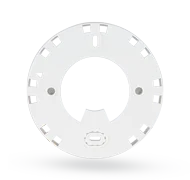
Related products
JA-152P
Wireless PIR motion detector
JA-159P
Wireless outdoor PIR detector
JA-161PW
Wireless PIR and MW combined detector
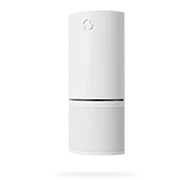
JA-162PW
Wireless dual PIR and MW motion detector
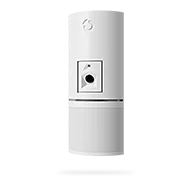
JA-162PC
Wireless PIR motion detector with a 90° verification camera
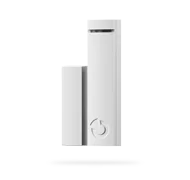
JA-153M
Wireless magnetic detector with recognition of external magnetic fields
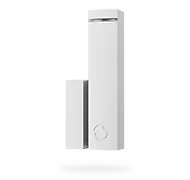
JA-150M
Wireless magnetic detector with 2 universal inputs
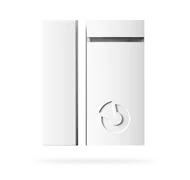
JA-155M
Wireless mini magnetic detector
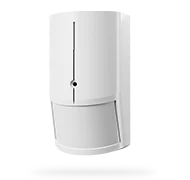
JA-180PB
Wireless PIR and glass-break combined detector
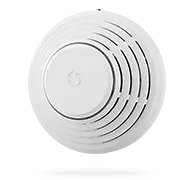
JA-150ST
Wireless fire and temperature detector
JB-EXT-TH-R
Wireless outdoor thermometer
JA-151TH
Wireless temperature detector
Help us improve the catalog
Missing something, or found a mistake? Let us know.