JA-150P
Wireless motion PIR detector
A version with an interchangeable lens for standard interiors. Coverage angle 110°, range 12 m. Adjustable immunity to false alarms, and it can be installed later on without any cabling.
Product line
- JABLOTRON 100+
- JABLOTRON Mercury
Compatibility
JA-100K, JA-101K, JA-106K, JA-103K, JA-107K, JA-108K, JA-102K, JA-152KRY
Check compatibilityKey specifications
- Power
- 2x Alkaline battery, type LR6 (AA) 1.5 V Please note: Batteries are not included
- Typical lifetime of batteries
- about 2 years (the longest lifetime is achieved in smartwatch mode)
- LowBatt state
- < 2,2 V
- Quiescent current consumption
- 15 µA
- Maximum current consumption
- 50 mA
- Communication frequency
- 868.1 MHz, JABLOTRON protocol
- Maximum radio-frequency power (ERP)
- 25 mW
Basic description
The passive infrared detector not only detects an intruder, it also serves for lighting automation and other scenarios. The optional corridor lens makes it a natural choice for long corridors as well.
- Adjustable sensitivity
- Fan-shaped characteristic; the optional JS-7910 lens does not cover the floor, for spaces with small animals
Why choose this product
How the detector works
It responds to changes in the thermal image within its field of view. It is triggered when it sees the movement of a larger body at a temperature close to that of a human. It is suitable for ordinary interiors where no sharp temperature fluctuations occur. Correct positioning is essential. If disturbing stimuli do appear in the area, the immunity can be increased.
- Covers a room of ordinary size
- Typically mounted in a corner, but also on a flat wall
One detector, plenty of functions
Besides picking up an uninvited guest, the detector can also be used for comfort functions. No additional sensors are needed. The alarm detector is therefore suitable for automating lighting or other appliances as well.
- Lights switched on automatically on movement after dark, and switched off automatically in a room where nobody has moved for a longer time
- Convenient switching of the air conditioning based on movement when entering the room
- Movement information passed on to the smart home
Positioning rules
A few basic rules have to be kept in mind for PIR detectors to work correctly. Given the detector's operating principle, unsuitable positioning may cause false alarms or insufficient coverage of the room.
- Keep to the recommended installation height and, after replacing the lens, verify that the detector covers the area correctly
- Avoid positioning it opposite windows and close to heating or air handling, where sharp temperature fluctuations are a risk
Frequently asked questions
They change the detection characteristic without you having to change the detector. The JS-7904 extends the range in a corridor, the JS-7910 leaves out the floor coverage for an area with an animal, and the JS-7902 creates a vertical detection wall. Verify the coverage with a walk test after every replacement.
The position is usually to blame, not the detector. Check whether heating, air conditioning, a billowing curtain or a window in direct sunlight reaches into the field of view. If the position is in order, switch the detector to the higher immunity level.
The recommended height is 2.2 to 2.5 m above the floor. Mounting it lower or higher changes the range and the layout of the detection zones, so always verify the coverage with a walk test after mounting.
Technical specifications
- Power
- 2x Alkaline battery, type LR6 (AA) 1.5 V Please note: Batteries are not included
- Typical lifetime of batteries
- about 2 years (the longest lifetime is achieved in smartwatch mode)
- LowBatt state
- < 2,2 V
- Quiescent current consumption
- 15 µA
- Maximum current consumption
- 50 mA
- Communication frequency
- 868.1 MHz, JABLOTRON protocol
- Maximum radio-frequency power (ERP)
- 25 mW
- Communication range
- approx. 300 m (unrestricted area)
- Recommended installation height
- 2.5 m above the floor
- Detection angle/detection coverage
- 110 degrees/12 m (with standard lens)
- Dimensions
- 60 x 95 x 55 mm
- Weight (without batteries)
- 80 g
- Classification
- Security grade 2/Environmental class II (according to EN 50131-1)
- Operational environment
- Indoor general
- Operating temperature range
- -10 °C to +40 °C
- Average operating humidity
- 75 % RH, without condensation
- Certification body
- Trezor Test s.r.o. (no. 3025), Telefication B.V.
- Complies with
- EN 50131-1, EN 50131-2-2, EN 50131-5-3, EN 50131-6, ETSI EN 300 220-1,-2, EN 50130-4, EN 55032, EN 62368-1, EN 50581, T 031
- Can be operated according to
- ERC/REC 70-03
- Recommended screw
- 2x o 3,5 x 40 mm (countersunk head)
Warning
- Do not touch the PIR sensor inside the cover, you could damage it.
- There should be no objects that change temperature rapidly, nor any moving objects, in the detector's field of view. Do not install it opposite windows or floodlights, or in places with air flow.
- Always replace all the batteries together. Before enrolling it again with the batteries inserted, take them out first and press the tamper contact so that the residual current is discharged.
- After installation, and whenever the lens or the height is changed, verify the coverage with a walk test. The actual range in the room differs from the figure in the table depending on what is in the way.
- When switching a light via a PG output, set the PG time longer than the reporting interval of the selected operating mode, otherwise the light will go out during continuous movement.
- The JA-121T module is needed to pass information on to the smart home.
- The increased immunity level cannot be used with the JS-7904 corridor lens.
Installation example
Choose a place at a height of 2.5 m, away from floodlights, heat sources, moving objects, animals and air flow.
Open the cover and take out the electronics. Do not touch the PIR sensor inside.
Punch out the holes for the screws in the rear plastic and screw it on vertically, with the cover latch facing downwards.
Put the electronics back in.
Insert both batteries and only then enrol the detector according to the control unit manual; the control unit must have a JA-11xR radio module.
Close the cover, secure it with the locking screw and verify its function with a walk test.
Related products
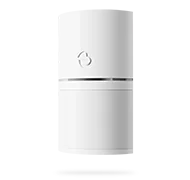
JA-152P
Wireless PIR motion detector
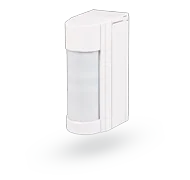
JA-159P
Wireless outdoor PIR detector
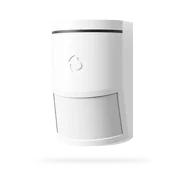
JA-161PW
Wireless PIR and MW combined detector
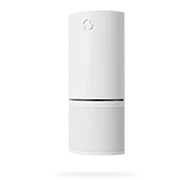
JA-162PW
Wireless dual PIR and MW motion detector
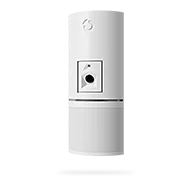
JA-162PC
Wireless PIR motion detector with a 90° verification camera
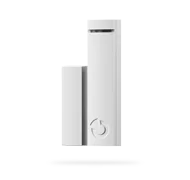
JA-153M
Wireless magnetic detector with recognition of external magnetic fields
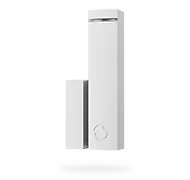
JA-150M
Wireless magnetic detector with 2 universal inputs
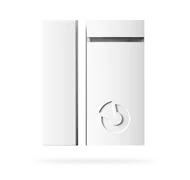
JA-155M
Wireless mini magnetic detector
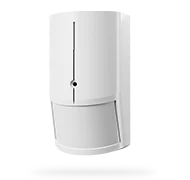
JA-180PB
Wireless PIR and glass-break combined detector
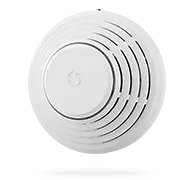
JA-150ST
Wireless fire and temperature detector
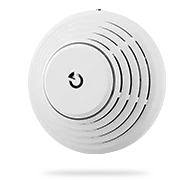
JA-151ST
Wireless combined smoke and heat detector with built-in siren
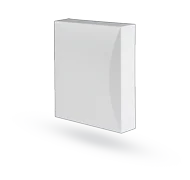
JB-EXT-TH-R
Wireless outdoor thermometer
Help us improve the catalog
Missing something, or found a mistake? Let us know.