JA-110A II
Bus internal siren with battery back-up
Indoor bus siren with a piezoelectric transducer and an acoustic pressure of 100 dB/1 m with a tolerance of ±5 dB. It signals an alarm by sound inside the building and also handles supplementary acoustic indication: entry and exit delays, programmable outputs or a doorbell with four melodies. It is classified as a type Z warning device with 24 h backup and occupies one position in the system.
Product line
- JABLOTRON 100+
- JABLOTRON Mercury
Compatibility
JA-100K, JA-101K, JA-106K, JA-103K, JA-107K, JA-108K, JA-102K
Check compatibilityKey specifications
- Power supply
- 12 V DC (9…15 V), from the BUS
- Optional back up battery
- BAT-3V2-CR2 (400 mAh)
- Current consumption in standby mode (quiescent)
- 5 mA
- Current consumption for cable choice (maximal)
- 120 mA
- Type of warning device
- type Z/12hr back-up
- Siren
- piezo-electric, 100 dB/m (±5 dB/m)
- Dimensions
- 80 x 80 x 35 mm
Basic description
The JA-110A II is the louder of the pair of indoor bus sirens: compared with the JA-110A, it delivers a 15 dB higher acoustic pressure, has a maximum current consumption of 120 mA for dimensioning the power supply, works with a 3.2 V LiFePO4 battery with a capacity of 0.4 Ah and is classified as a type Z warning device with 24 h backup. Where basic acoustic signalling inside the building is sufficient, the JA-110A will do. Visual warning outside the building is provided by the JA-113A outdoor siren with an LED light guide and two-colour LEDs.
- Signals an alarm by sound inside the building. The piezoelectric transducer delivers an acoustic pressure of 100 dB/1 m with a tolerance of ±5 dB.
- Power and communication via the bus. Nominal 12 V DC within the range 8 to 15 V, rated consumption 5 mA and maximum 120 mA.
- Add backup directly in the siren. The BAT-3V2-CR2 battery (3.2 V LiFePO4, 0.4 Ah) maintains the acoustic performance even on bus lines longer than 100 m.
- It also serves as a doorbell. For each programmable output, choose beeping, a twenty-second signal or one of four melodies.
Why choose this product
Alarm signalling and the siren button
The siren sounds during an alarm in the selected sections, by default in all of them. By default, it responds to the internal warning signal IW; it can be switched to the external warning EW, or alarm sounding can be disabled completely while the other functions are retained. It can distinguish a fire alarm by fast beeping, the same as smoke detectors with an internal siren. The order of indications is fixed: first a fire alarm, then an alarm of internal and external warning, warning, unsetting with alarm memory, section control, entry, exit, alarm memory and finally indication of programmable outputs. Pressing the siren silences the alarm and confirms that someone is present in the building; in F-Link, this reaction can be changed, for example to sending a hold-up alarm.
- Piezoelectric transducer, acoustic pressure 100 dB/1 m (±5 dB)
- Siren time limited to 1 to 5 minutes or according to the alarm length from the control unit
- Four doorbell melodies and sounding of programmable outputs
Bus power and backup in the siren
The siren is powered and communicates via the control unit bus; an additional energy reserve is provided by its own battery, which is ordered separately. The siren detects the connected cell itself and performs full diagnostics on it: it measures and displays the relevant values and warns the engineer and the user of approaching discharge through the usual channels. The siren keeps working, but the replacement should be scheduled within two weeks and is carried out by a technician in service mode. Returning to operation without its own backup requires a short reinitialisation, otherwise the siren does not register the change.
- Bus 12 V DC within the range 8 to 15 V, rated consumption 5 mA, maximum 120 mA
- Type Z warning device with 24 h backup
- BAT-3V2-CR2 battery (3.2 V LiFePO4, 0.4 Ah), order separately
Location and indoor installation
The siren is intended for an indoor – general environment and is mounted inside the building. It is fixed directly to the wall surface or onto an electrical installation box; the cover is slightly deeper than on the basic model, so take this into account for flush mounting. The bus cable is passed through a knock-out opening in the base, which is screwed to the wall; if a battery is used, it is placed against the top wall and secured by fitting the middle frame. The siren body is then inserted back so that the tamper sensors lie above the magnets: the front protective contact monitors removal of the body, the rear contact pulling off the wall. The siren is an addressable peripheral that you enrol in F-Link by selecting a position, pressing its button or entering the serial number.
- Occupies one position in the system
- Range −10 to +40 °C, humidity 75% RH, non-condensing
- Security Grade 2, environmental class II, dimensions 80 × 80 × 35 mm
Frequently asked questions
No, order it separately: type BAT-3V2-CR2 (3.2 V LiFePO4 CR2, 0.4 Ah); do not use any other type. Once it is connected, the siren detects it itself, continuously measures its condition and reports low voltage at 2.9 V. The replacement is carried out by a technician in service mode.
When the bus line to the siren exceeds 100 m: on a long line, the voltage drop can reduce the acoustic performance, and the battery maintains it. The second reason is independence from the bus power supply, because the siren then has its own energy reserve. After the battery is disconnected, a reinitialisation is necessary, otherwise the siren does not register the change.
The JA-113A outdoor siren. It has an LED light guide with two-colour LEDs, its idle flashing shows that the building is equipped with a working security system, and it signals an alarm by both sound and light outside the building. The JA-110A II remains the acoustic signalling inside the building: it alerts people on site and also handles entry delay, programmable outputs and the doorbell.
Technical specifications
- Power supply
- 12 V DC (9…15 V), from the BUS
- Optional back up battery
- BAT-3V2-CR2 (400 mAh)
- Current consumption in standby mode (quiescent)
- 5 mA
- Current consumption for cable choice (maximal)
- 120 mA
- Type of warning device
- type Z/12hr back-up
- Siren
- piezo-electric, 100 dB/m (±5 dB/m)
- Dimensions
- 80 x 80 x 35 mm
- Weight (with battery)
- 92 g
- Classification
- security grade 2/environmental class II (according to EN 50131-1)
- Environment
- Indoor general
- Operating temperature range
- -10 °C to +40 °C
- Average operating humidity
- 75 % RH, without condensation
- Complies with
- EN 50131-1, EN 50131-4, EN 50130-4, EN 55032, EN 62368-1, EN 50581
- Certification body
- Trezor Test s.r.o. (no. 3025)
Warning
- Always connect the bus with the system power completely switched off. Mount the siren inside the building, in an indoor – general environment of class II, within the range −10 to +40 °C and at humidity of up to 75% RH, non-condensing. For signalling outside the building, use the JA-113A outdoor siren with an LED light guide. The siren is not fitted with a battery from the factory; order the BAT-3V2-CR2 back-up battery separately and do not use any other type. When calculating the permissible voltage drop on the bus, work with the lower limit of 8 V. The value of 120 mA is the maximum current consumption, not a quota for cable selection. With bus lines longer than 100 m, add the battery, otherwise the acoustic performance may drop due to the voltage drop on the line. The battery is replaced by a technician in service mode, within two weeks of the approaching discharge being reported. Switching to operation without the battery requires disconnecting from the bus, unplugging the battery, a 10 s pause and reconnecting, otherwise the siren does not register the change. When inserting the body, the tamper sensors must lie above the magnets, otherwise the siren reports tamper. The volume setting of the supplementary acoustic indication has no effect on the alarm volume. Installation may only be carried out by a trained technician holding a valid JABLOTRON certificate.
Installation example
Always connect the bus with the system power completely switched off.
Prise the siren body out of the plastic frame with a flat screwdriver in the vertical slot.
Remove the middle part of the frame by pressing the four latches.
Break out the knock-out opening in the base and pass the bus cable through it.
Screw the base to the wall surface or onto an electrical installation box with 2× Ø 3.5 × 40 mm countersunk head screws; if a battery is used, place it against the top wall.
Fit the middle frame back onto the base; this secures the battery in place.
Connect the bus cable to the terminals and, if applicable, the battery to the connector.
Insert the siren body back into the frame so that the tamper sensors lie above the magnets in the base.
In F-Link, select a position on the Devices tab, use Enrol to start Scan/add new BUS devices and enrol the siren with a double click; the yellow LED goes off.
In Internal settings, set the sections, reaction, siren time, volume and signalling of programmable outputs.
Related products
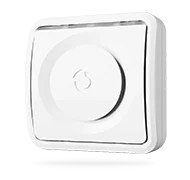
JA-110A
Bus internal siren
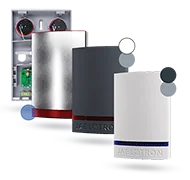
JA-111A
Bus external siren
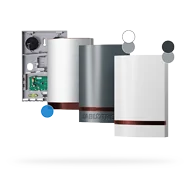
JA-113A
Bus external siren
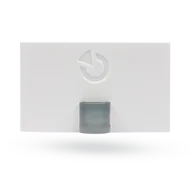
JA-112I
Bus section/output PG activation indicator
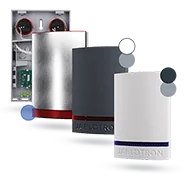
JA-163A
Wireless outdoor battery powered siren
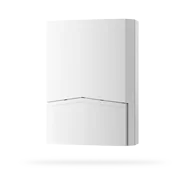
JA-154A
Wireless battery indoor siren

JA-152A
Wireless internal siren for an AC socket
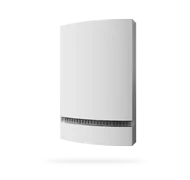
JA-1X2A-C-WH
Plastic cover for JA-113A, JA-111A, JA-151A and JA-163A - white, transparent light guide
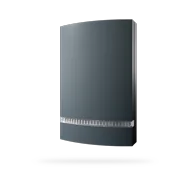
JA-1X2A-C-AN
Plastic cover for JA-113A, JA-111A, JA-151A and JA-163A - anthracite, transparent light guide
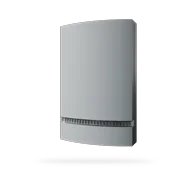
JA-1X2A-C-GR
Plastic cover for JA-113A, JA-111A, JA-151A and JA-163A - grey, transparent light guide
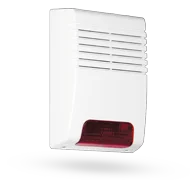
OS-350
Siren
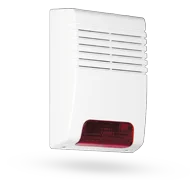
OS-365A
Outdoor siren
Help us improve the catalog
Missing something, or found a mistake? Let us know.