OS-365A
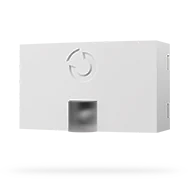
Outdoor siren
Outdoor siren with a back-up battery that starts sounding and flashing the moment the power supply line is interrupted. Sounding and flashing can also be controlled separately, each by its own terminal, and the ARM terminal confirms setting and unsetting. Sound is produced by a compression magneto-dynamic loudspeaker with an acoustic pressure of 110 dB/1 m.
Key specifications
- Power supply
- 10 to 15 V DC
- Standby consumption
- < 50 mA/12 V
- Maximum load consumption
- < 800 mA/12 V
- Backup battery
- NiCd pack 4.8 V/1800 mAh Lifetime approx. 3 years
- Electro-acoustic siren sound level
- 110 dB/1 m
- Siren timer
- max. 5 minutes
- Flasher time
- alarm duration +15 minutes/0
Basic description
The two outdoor sirens of the OS range differ in their activation logic, and that is what you choose by. The OS-365A has backup: it starts sounding and flashing when the power supply line is interrupted and reacts in the same way to switching of the SIR terminal, drawing energy from its own battery. The OS-350 has no backup and behaves the other way round: it sounds for as long as the control unit supplies it with power. In addition, the version with backup allows the flasher to be controlled separately, setting and unsetting to be confirmed, and the battery voltage to be measured without opening the cover.
- Even an interruption of the power supply triggers an alarm. When the supply is disconnected, it starts sounding and flashing from its own battery.
- Power supply 10 to 15 V DC, standby consumption below 50 mA and below 800 mA in alarm at 12 V. It is connected via the terminals +12V, GND, SIR, FLA, ARM and a pair of TMP terminals.
- Acoustic pressure 110 dB/1 m. Sound is produced by a compression magneto-dynamic loudspeaker.
- Outdoor – general environment, class IV. IP 34D ingress protection, range −25 to +60 °C and Security Grade 2.
Why choose this product
Alarm signalling
Sounding and flashing are separate functions, each triggered by its own terminal, so the flasher can run even without sound. As a result, the alarm remains visible long after the siren falls silent, and the surroundings can orient themselves by the light. The body of mechanically resistant plastic withstands UV radiation and weather, and the flasher is fitted with LEDs.
- Compression magneto-dynamic loudspeaker, acoustic pressure 110 dB/1 m
- Sounding for a maximum of 5 minutes; with the FLASH jumper in the ON position, the flasher continues flashing for another 30 minutes
- The ARM terminal confirms setting and unsetting
Power supply and back-up battery
The power terminals also recharge the back-up battery, which the siren looks after with its own charging mode. Jumpers on the board determine whether the inputs react to connection to ground or to its disconnection, whether the flasher keeps flashing for a while after an alarm, and whether the siren reports its readiness with a regular flash. The battery voltage can be measured with a voltmeter at the terminals directly in the control unit, without opening the cover.
- Power supply 10 to 15 V DC, standby below 50 mA, alarm below 800 mA at 12 V
- NiCd battery 4.8 V/1800 mAh, service life approximately 3 years
- Terminals +12V, GND, SIR, FLA, ARM and a pair of TMP terminals
Application and installation
The siren belongs in an outdoor – general environment and is mounted in a place that is not easily accessible, ideally sheltered from direct rain, for example under a roof overhang. Choose the location so that the sound can spread freely to the surroundings. Two tamper sensors report both opening of the cover and tearing of the siren off its mounting surface.
- IP 34D ingress protection, environmental class IV, −25 to +60 °C
- Security Grade 2 according to EN 50131-1 and EN 50131-4
- Dimensions 230 × 158 × 75 mm, tamper loop resistance below 70 Ω
Frequently asked questions
Via the ARM terminal. Connecting ARM to GND means setting: the siren flashes once and gives one short sound. Disconnecting it means unsetting: the siren flashes once and gives two short sounds. The user thus hears and sees that the building has actually been set.
With the NC/NO jumper in the ON position, the voltage can be measured directly at the ARM, FLA and SIR terminals. With a voltmeter, you can measure the battery voltage during charging, under the flashing load and under the sounding load, without having to open the siren. The measurement is always taken with a voltmeter on one of the conductors after disconnecting it from GND.
With a regular flash. With the OK jumper in the ON position, it flashes once every 45 s if the terminals are in the idle state and the power supply and battery are in order. The flash is therefore also a continuous confirmation that the backup is working.
Technical specifications
- Power supply
- 10 to 15 V DC
- Standby consumption
- < 50 mA/12 V
- Maximum load consumption
- < 800 mA/12 V
- Backup battery
- NiCd pack 4.8 V/1800 mAh Lifetime approx. 3 years
- Electro-acoustic siren sound level
- 110 dB/1 m
- Siren timer
- max. 5 minutes
- Flasher time
- alarm duration +15 minutes/0
- Resistance of the tamper loop
- < 70 Ohms
- Enclosure
- IP 34D
- Security grade 2
- EN 50131-1, CLC/TS 50131-4
- Working environment
- class IV, outdoor general
- Operational temperature
- -25 to +60°C
- EMC
- EN 50130-4, EN 55022
- Safety
- EN 60950-1
- Dimensions
- 230 x 158 x 75 mm
Warning
- If the activation conditions are met at the SIR or FLA terminals at the moment the power supply is connected, the siren starts sounding after 3 s; take this possibility into account when wiring. Before disconnecting the +12V terminal and before any handling of the terminal block, disconnect the battery first, otherwise both the siren and the flasher activate. If the siren is disconnected from the power supply for a long time, also unplug the battery from the connector on the board. Sounding is always limited to 5 minutes, even if the power supply is permanently disconnected. Do not mount near gutters where ice may form in the winter months. Protect your hearing during testing; the siren has a high acoustic output. Activating the siren with the electroacoustic transducer connector disconnected does not damage the circuits, but high voltage appears on the connector.
Installation example
Before disconnecting the +12V terminal and before any handling of the terminal block, disconnect the battery first, otherwise the siren activates.
Loosen the screws under the caps and open the cover by tilting it upwards; the cover stays hanging on the suspension cord.
Fix the base of the siren at the selected location.
Pass the supply cable through the opening in the base and tighten the fixing screws.
Connect the cable to the terminals +12V, GND, SIR, FLA, ARM and TMP.
Press the cable under the plastic latches to the left of the board.
Connect the battery; it is disconnected at the factory.
Fit the cover, tighten the screws and slide on the plastic screw caps.
Switch on the siren power supply in the control unit and test the function; after 3 s, the siren flashes.
Related products
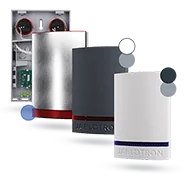
JA-163A
Wireless outdoor battery powered siren
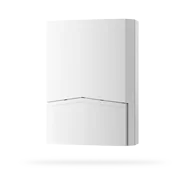
JA-154A
Wireless battery indoor siren

JA-152A
Wireless internal siren for an AC socket

JA-110A
Bus internal siren

JA-110A II
Bus internal siren with battery back-up
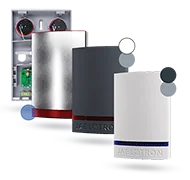
JA-111A
Bus external siren
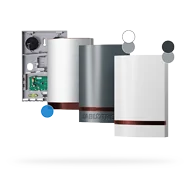
JA-113A
Bus external siren
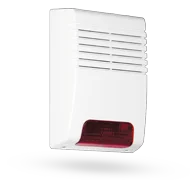
OS-350
Siren
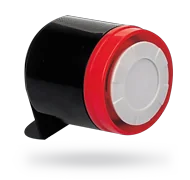
SA-105
Piezoelectric siren
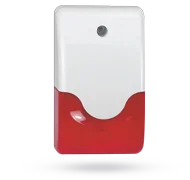
SA-913FM
Piezoelectric siren
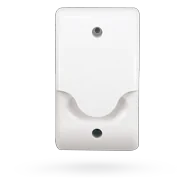
SA-913TM
Piezoelectric siren
JA-111I
Universal LED indicator RGB
Help us improve the catalog
Missing something, or found a mistake? Let us know.