JA-191Y
LTE communicator module
LTE communicator module for the control unit, connected to the mobile network. It reports alarms to the Alarm Receiving Centre using a digital protocol, sends alarm SMS messages and allows remote control and remote configuration. It is installed by a trained technician.
Compatibility
JA-100K, JA-101K, JA-106K
Check compatibilityKey specifications
- Module power supply
- 8–15 V DC (from the control panel)
- Average current consumption
- approx. 22 mA (depends on cellular network signal strength)
- Peak current consumption
- 670 mA
- GSM communication band
- 2G (GSM, EDGE) 900/1800 MHz
- I&HAS classification
- Security grade 2/Environmental class II (according to EN 50131-1)
- Dimensions
- 82 x 38 x 32 mm
- Weight
- 29 g
Basic description
With this pair, a single question decides: stay with the telephone line or move to the mobile network. Both modules play the same role in the control unit: they connect it to the Alarm Receiving Centre, deliver voice alarm messages and are configured in the F-Link software. The JA-191Y also sends alarm SMS messages and allows the system to be configured remotely.
- Reports alarms to the Alarm Receiving Centre and delivers voice alarm messages; the communicator is configured in the F-Link software.
- Connects via a nano SIM card, preferably to the LTE network; where LTE is not available, it switches to an older network.
- The daily limit is 5 to 250 minutes of calls, 5 to 250 SMS messages and 0 to 245 alarm SMS messages.
- Complies with security grade 2 and environmental class II according to EN 50131-1; this applies only in combination with a control unit certified for security grade 2.
Why choose this product
What the module reports and how
The module reports alarms over the mobile network using a digital protocol, sends alarm SMS messages and allows remote control and remote configuration via a web or mobile application.
- Digital transmission using the JABLO IP or ANSI SIA DC-09 protocol over the mobile network, alarm SMS messages using the JABLO SMS protocol.
- Supports voice calls over the LTE network (VoLTE).
- It checks network registration and signal strength, which should be at least 30 %.
What the control unit needs
Plugs directly into the expansion module connector on the control unit board.
- Powered from the control unit at 12 V; the nominal current draw is approximately 22 mA depending on signal strength, maximum 670 mA.
- Requires an activated nano SIM card with SMS, data, voice and caller ID services, with the PIN request disabled.
- Access to the voice menu can be restricted to system users or allowed from any telephone.
Where it is mounted and what it needs
Mounted inside the control unit on its board; the antenna screws into the connector on the module.
- The antenna is supplied; the module must not be put into operation without it.
- Network registration takes approximately 1 minute.
- Works in the range −10 °C to +40 °C at an average operating humidity of up to 75 %, non-condensing.
Frequently asked questions
You move to the mobile network; instead of a telephone line, you need an activated SIM card.
Check this in the compatibility overview on the website; it will confirm which control units this module works with.
Technical specifications
- Module power supply
- 8–15 V DC (from the control panel)
- Average current consumption
- approx. 22 mA (depends on cellular network signal strength)
- Peak current consumption
- 670 mA
- GSM communication band
- 2G (GSM, EDGE) 900/1800 MHz
- I&HAS classification
- Security grade 2/Environmental class II (according to EN 50131-1)
- Dimensions
- 82 x 38 x 32 mm
- Weight
- 29 g
- Operational environment
- indoor general
- Operational temperature
- -10 °C to 40 °C
- Average operational humidity
- 75% RH, non-condensing
- Compatible with RCT (ARC receiver)
- According to communication protocols
- SPT communicator type
- SPT type Z (control panel expansion module)
- AS/SPT interface
- Pass-through
- Certification body
- Trezor Test (No. 3025)
- In compliance with
- EN 62368-1, ETSI EN 301 511, EN 50130-4, ETSI EN 301 489-1, ETSI EN 301 489-52, ETSI EN 301 486-19, ETSI EN 301 908-1, ETSI EN 301 908-13, ETSI EN 301 908-2, ETSI EN 303 413, EN 55032, EN 50665, EN 50581, EN 50131-1, EN 50131-3, EN 50131-10, EN 50136-1, EN 50136-2, ANSI SIA DC-09.
- Operating conditions
- ECC/DEC/(12)01, ERC/DEC/(97)02, ECC/DEC/(06)01
Warning
- A directional or high-gain antenna is not recommended; a weaker signal reduces transmission reliability.
Installation example
If a JA-190X module was previously used in the control unit, disable it in the F-Link software on the Communication tab while it is still in the control unit; once it has been removed, this is no longer possible.
Disconnect both the rechargeable battery and the mains power supply of the control unit.
Plug the module into the expansion module connector on the control unit board.
Insert an activated nano SIM card with SMS, data, voice and caller ID services and with the PIN request disabled.
Connect the supplied antenna; the module must not be in operation without it.
Switch on the power and complete the settings in the F-Link software on the Communication tab.
Related products
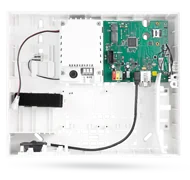
JA-103K
Control panel JA-103K
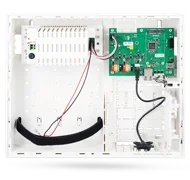
JA-107K
Control panel JA-107K
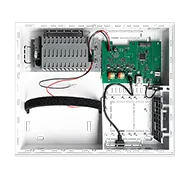
JA-108K
Control panel JA-108K
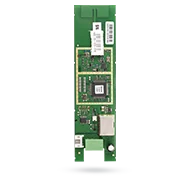
JA-111R
Bus interface for JA-100 wireless devices
JA-103KR
Control panel JA-103KR
JA-103K-7AH
Control panel JA-103K-7AH
JA-107KR
Control panel JA-107KR
JA-194Y
LTE communicator module
JA-194Y-LITE
LTE communicator module
JA-121T
RS-485 bus interface
JA-112R
Bus module for connecting JA-100 wireless components
JA-190X
Telephone communicator module
Help us improve the catalog
Missing something, or found a mistake? Let us know.