AC-160-DIN
Wireless multifunctional relay for DIN-rail installation
Wireless multifunction relay of the JABLOTRON system with a changeover output contact, controlled by the control unit via a command to the assigned programmable output. Without a control unit, it can also switch on its own, according to detectors and remote controls enrolled directly to it.
Compatibility
JA-100K, JA-101K, JA-106K, JA-103K, JA-107K, JA-108K
Check compatibilityKey specifications
- Operational power
- 230 V/50 Hz
- Own power consumption for 230 V AC (min/max)
- 0.5 W/1.7 W
- Communication band
- 868.1 MHz, Jablotron protocol
- Antenna
- Internal/optional external antenna type AN-868
- - Maximum switching voltage
- 250 V AC
- - Resistive load (cos φ=1)
- max. 16 A
- - Inductive, capacitive load (cos φ=0,4)
- max. 8 A
Basic description
The choice between the two multifunction relays depends on the mounting location: the AC-160-C fits inside a plastic electrical junction box, the AC-160-DIN belongs on a DIN rail in a distribution board. Both are enrolled to the system as wireless peripherals and controlled by the control unit. Where equipment needs to be switched only according to a voltage signal, without a link to the control unit, the RB-524-DIN steps in instead.
- Wireless multifunction relay that the control unit controls remotely. In stand-alone mode, it switches even without a control unit, according to detectors and remote controls enrolled directly to it.
- It communicates using the JABLOTRON wireless protocol. In addition to the built-in antenna, it also has a connector for an external antenna if the installation requires it.
- The relay firmware can be updated by a user with Service authorisation via a MicroUSB connection and the F-Link software.
Why choose this product
What the relay switches and how
The relay switches according to a command from the control unit to the assigned programmable output. Without a control unit, it works independently in stand-alone mode, in which it is triggered by detectors or remote controls enrolled directly to it.
- Stand-alone mode: detectors and remote controls are enrolled directly to the relay, up to 64 devices in total. It accepts one-way JA-15x series detectors and JA-15xJ MS or JA-16xJ remote controls; it does not support JA-18x series detectors.
- The common timer for the switching time can be set from 1 second to 23:59:59; preset values of 3 seconds, 1 minute, 3 minutes, 15 minutes and 30 minutes are also available.
- The relay returns to the idle state if a communication failure with the control unit lasts longer than 1 minute; for an enrolled detector, the interval for returning to idle is 20 minutes. After communication is restored, the state stabilises within 2 minutes at the latest, or within 9 minutes for detectors with periodic transmission.
What the system needs for it
The relay is a peripheral like any other: in the F-Link software, on the Devices tab, you select the position to which the relay is enrolled and configure its behaviour there.
- The control unit must be fitted with a JA-11xR radio module.
- It occupies one position in the control unit.
- It communicates at 868.1 MHz; operating conditions are governed by the general authorisation of the Czech Telecommunication Office (ČTÚ).
Where it is mounted and what it switches
The relay is mounted on a DIN rail in a distribution board as a single module, achieves a higher ingress protection with the additional cover panel, and is wired via its changeover output contact.
- It switches voltages up to 250 V AC, resistive loads up to 16 A, inductive and capacitive loads up to 8 A and halogen lighting up to 1000 W. The minimum switched DC power is 0.5 W. This is functional single-pole switching that does not provide safe disconnection.
- Temperature −10 °C to +40 °C, humidity up to 75% RH, non-condensing, IP20 ingress protection, IP40 with the additional cover panel.
- Own power consumption at 230 V AC 0.5 to 1.7 W.
Frequently asked questions
Yes, in stand-alone mode. Detectors and remote controls, up to 64 devices in total, are enrolled directly to it, and it switches without any intervention from the control unit according to the mode set for the individual detectors and remote controls.
The AC-160-DIN belongs on a DIN rail in a distribution board. The AC-160-C is intended for places where a plastic electrical junction box belongs.
Technical specifications
- Operational power
- 230 V/50 Hz
- Own power consumption for 230 V AC (min/max)
- 0.5 W/1.7 W
- Communication band
- 868.1 MHz, Jablotron protocol
- Antenna
- Internal/optional external antenna type AN-868
- - Maximum switching voltage
- 250 V AC
- - Resistive load (cos φ=1)
- max. 16 A
- - Inductive, capacitive load (cos φ=0,4)
- max. 8 A
- - Halogen lights
- max. 1000 W
- - Minimum switching DC power
- 0.5 W
- Recommended connection wires
- max. 2 x 1.5 mm 2 ; max. 1 x 2.5 mm 2
- IP covering
- IP-20 (according to EN 65529), IP-40 (with a front panel)
- Dimensions
- 18 x 90 x 64 mm
- Weight
- 65 g
- Operational temperature range
- -10 °C to + 40 °C, relative humidity 75% no condensation
- Complies with
- ETSI EN 300 220-1, EN 50130-4, EN 55022, EN 60950-1, EN 50581
- Can be operated to
- ERC REC 70-03
Warning
- Connection to the mains is always a job for a qualified person. The relay itself does not provide safe disconnection of an appliance from the mains; where the project requires it, it must be provided by another element of the installation.
Installation example
Connection to the mains may only be carried out by a qualified person.
Fit the relay as a single module on a DIN rail in the distribution board.
Connect the 230 V supply wires to the power terminals and switch on the power.
Enrol the relay to a free position of the control unit in the F-Link software by holding the Learn/Set button for longer than 3 seconds.
After enrolment, test switching with the button on the front panel and only then connect the switched equipment.
Related products
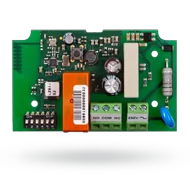
JA-150N
Wireless power output module PG
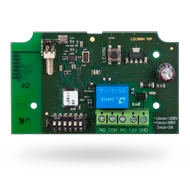
JA-151N
Wireless signal output module PG
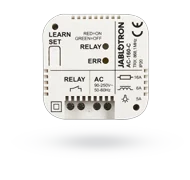
AC-160-C
Mounting-box-fitted wireless multifunctional power relay
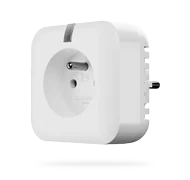
JB-160N-PLUG
Smart Wireless Plug (French)
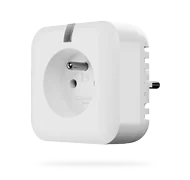
JB-164N-PLUG
Smart Socket with Consumption Measurement (French)
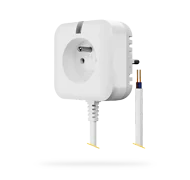
JB-162N-PLUG
Wireless plug with external output (French)
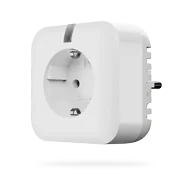
JB-161N-PLUG
Smart Wireless Plug (Schuko)
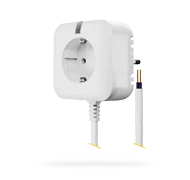
JB-163N-PLUG
Wireless plug with external output (Schuko)
JB-165N-PLUG
Smart Socket with Consumption Measurement (Schuko)
JB-110N
Bus PG power output module
JA-110N-DIN
Bus DIN power output module
JB-111N
Bus signal PG output module
Help us improve the catalog
Missing something, or found a mistake? Let us know.